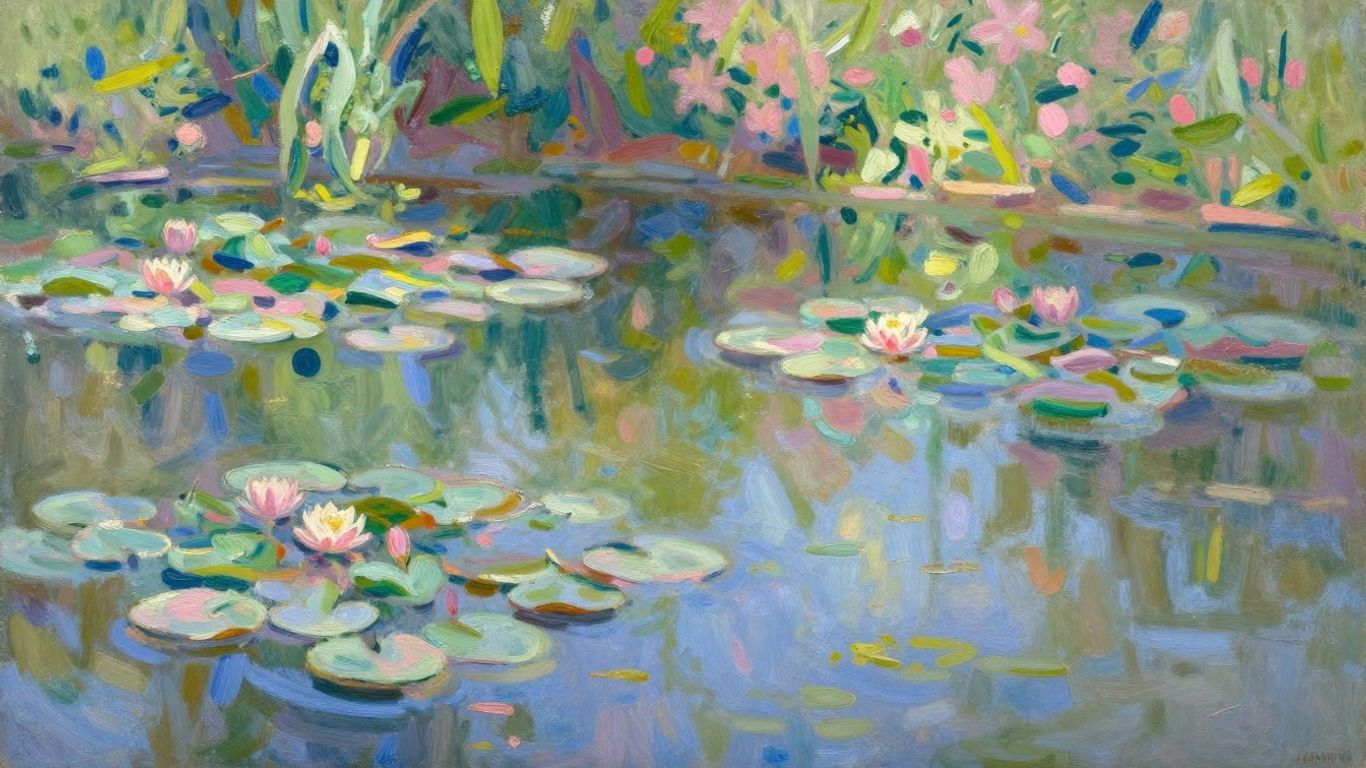
Claude Monet’s paintings are more than just pretty pictures; they’re windows into a revolutionary way of seeing. This guide explores the enduring beauty of a painting of Monet, from his early days challenging art’s establishment to the immersive experiences waiting for you in Paris and beyond. We’ll look at what made his work so special and why it still captivates us today. Get ready to discover the magic of Impressionism through the eyes of its master.
Key Takeaways
- Monet was a leader in Impressionism, a movement that broke from traditional art by focusing on light, color, and capturing fleeting moments, often painted outdoors.
- His famous “Water Lilies” series and the painting “Impression, Sunrise” are key examples of his innovative style and his break with artistic norms.
- Visiting museums like the Musée Marmottan Monet and Musée de l’Orangerie in Paris offers a direct way to experience Monet’s vision, with Giverny providing a pilgrimage to his home and gardens.
- Monet’s techniques centered on his deep fascination with how light affects color, using quick brushwork to capture immediate visual sensations rather than precise detail.
- Monet’s work paved the way for modern art, transformed the art market, and continues to hold a powerful appeal for people across generations.
Understanding Claude Monet: The Pioneer Of Impressionism

A Life Dedicated to Capturing Light
Born in Paris back in 1840, Oscar-Claude Monet wasn’t always destined for art fame. His early days in Le Havre involved making witty caricatures, which actually paid the bills and showed a knack for quick observation. But a chance meeting with Eugène Boudin changed everything. Boudin introduced him to painting outdoors, a concept that was pretty radical back then. Most artists stayed in studios, relying on sketches. Monet, however, was hooked on seeing how light changed a scene from one minute to the next. He became obsessed with capturing that fleeting moment, that specific feeling of light on a subject. It wasn’t just about painting a tree; it was about painting the light on the tree, right then and there.
The Revolutionary Concept Of Painting En Plein Air
Painting outside, or en plein air, was a game-changer for Monet and his friends. Imagine ditching the stuffy studio for the open air, the wind, and the unpredictable light. This approach meant artists had to work fast, using visible brushstrokes and bright colors to capture the immediate impression of a scene. It was a direct challenge to the polished, detailed style favored by the art academies of the time. Monet believed that the true subject wasn’t just the object itself, but the interplay between the object and the light surrounding it. He famously said, "The motif is insignificant to me; what I want to reproduce is what exists between the motif and me." This focus on subjective experience and the transient effects of nature became the heart of Impressionism.
A Circle Of Rebellious Artists
Monet wasn’t alone in his artistic rebellion. He found kindred spirits in artists like Pierre-Auguste Renoir, Alfred Sisley, and Frédéric Bazille. They formed a tight group, sharing ideas, critiquing each other’s work, and often struggling financially together. They were tired of the traditional art world, especially the Salon, which dictated what was considered ‘good’ art. Their work focused on modern life, landscapes, and everyday scenes, painted with a fresh, spontaneous energy. They wanted to show the world as they saw it, not as some dusty old rulebook said it should be painted. This shared desire to break free and capture the world in a new way fueled their creativity and ultimately gave birth to Impressionism.
The Enduring Light Of Monet’s Masterpieces

Monet’s career wasn’t just about painting pretty pictures; it was a relentless quest to capture something incredibly fleeting: light itself. He became obsessed with how light changed everything – the color of a haystack, the facade of a cathedral, or even just a simple water lily. This obsession led him to create some of his most famous and impactful works, series that show the same subject over and over, but each time looking completely different.
The Iconic Water Lilies Series
This is probably what Monet is most famous for, right? His water lilies, or "Nymphéas," are just stunning. He spent the last 30 years of his life painting them, mostly at his home in Giverny. He had this amazing garden with a pond, complete with a Japanese bridge, and he just painted it endlessly. It wasn’t just about the flowers themselves, though. He was fascinated by the reflections on the water – the sky, the clouds, the trees. These paintings became less about depicting reality and more about capturing a feeling, an atmosphere. Towards the end, they get really abstract, almost like pure color and light. It’s like he was painting the surface of the water itself, and what it reflected.
- Around 250 paintings dedicated to the water lilies.
- Explored every time of day and season to see how light changed the scene.
- Later works dissolve traditional perspective, creating an immersive experience.
Monet’s garden at Giverny wasn’t just a place he lived; it was his studio, his sanctuary, and his ultimate subject. He cultivated it specifically to paint, arranging plants and flowers for their color and form, and how they interacted with the light throughout the day and year. It was a controlled environment where he could endlessly study nature’s subtle shifts.
Impression, Sunrise: A Break From Tradition
This painting is kind of a big deal because it literally gave Impressionism its name. When it was first shown, a critic used the title "Impression, Sunrise" to mock the style, saying it was just an "impression" and not a finished painting. But Monet and his friends kind of embraced it. The painting itself shows the port of Le Havre at sunrise, with hazy light and visible brushstrokes. It wasn’t trying to be super detailed or realistic like the art that came before. It was about capturing that specific moment, that feeling of the morning light hitting the water and the industrial landscape. It was a bold statement against the traditional art world.
The Haystack And Rouen Cathedral Series
Monet really got into painting the same thing multiple times. His Haystack and Rouen Cathedral series are perfect examples. He’d set up his easel in front of a haystack or the cathedral and just paint it over and over again, at different times of the day, in different weather, and in different seasons. He wanted to see how the light and atmosphere affected the colors and shapes. For the cathedrals, he painted the facade dozens of times, from various angles and under countless light conditions. It’s like he was trying to capture the very essence of the subject as it changed moment by moment. It shows his dedication to observing the world and how light truly transforms everything we see.
Experiencing Monet’s Vision In Paris
So, you’re in Paris and want to see some actual Monet paintings? It’s totally doable, and honestly, it’s the best way to get what he was all about. Forget just looking at pictures online; seeing these works up close is a whole different ballgame. Paris has two main spots that are pretty much dedicated to him, and they offer really different vibes.
Musée Marmottan Monet: An Intimate Sanctuary
This place is tucked away in a quieter part of the city, and it feels super personal. It’s got a massive collection of Monet’s work, including his famous "Impression, Sunrise," the painting that basically gave the whole Impressionist movement its name. It’s like walking through his personal studio, with a lot of his later works and pieces from his family. You really get a sense of the man behind the brushstrokes here. It’s not overwhelming, which is nice when you’re trying to take it all in.
Musée de l’Orangerie: An Immersive Meditation
Now, the Orangerie is something else entirely. It’s famous for its huge, oval rooms where Monet’s "Water Lilies" paintings are displayed. They’re enormous, wrapping around you. It’s designed so you can just sit and get lost in them. It feels less like a museum and more like a peaceful escape. It’s a really meditative experience, especially the way the light changes in the rooms throughout the day.
Beyond The Museums: A Pilgrimage To Giverny
If you’re really serious about seeing Monet’s world, you’ve got to make the trip to Giverny. It’s about an hour outside Paris by train. This is where Monet lived for decades and where he created his famous water gardens. Walking through the gardens, seeing the lily pond and the Japanese bridge – it’s like stepping right into his paintings. You can see the actual places that inspired so much of his work. It’s a bit of a journey, but totally worth it to connect with his inspiration directly.
Monet’s Techniques And Artistic Philosophy
So, how did Monet actually do it? It wasn’t just luck or a magic paintbrush. He had some pretty specific ideas about how to paint and what art should even be about. It really boils down to a few key things.
The Obsession With Light And Color
This is the big one, folks. Monet wasn’t just painting things; he was painting the light hitting those things. He figured out that color isn’t really in an object itself, but rather how light bounces off it. And since light changes all the time – morning, noon, night, different seasons – he had to paint fast to catch that exact moment. He wanted to get the feeling of the light, not just a picture of a haystack.
Innovative Brushwork And Application
Forget smooth, blended paintings like you see in older art. Monet used short, choppy strokes of pure color. Seriously, sometimes if you stand too close, it just looks like a mess of dots. But step back a bit, and your eyes do the work, mixing those colors together. It makes the whole painting feel alive and shimmering, kind of like how light actually behaves. He also stopped mixing colors so much on his palette. Instead, he’d put colors right next to each other on the canvas, especially ones that look good together, like blue and orange. This made his paintings pop with a brightness you just didn’t see before.
Subjective Perception Over Academic Exactitude
Monet wasn’t trying to win awards from the stuffy art academies. He didn’t care about perfect, photographic realism. What mattered to him was what he saw and felt. He wanted to capture that fleeting moment, that personal experience of seeing something. He famously said the subject itself wasn’t that important; it was what happened between him and the subject that he wanted to show. It was all about his personal take on the world, not some rigid rulebook.
He believed that art should make you feel something, not just tell you a story or show you a perfect copy of reality. It was about the sensation, the atmosphere, the way light danced on a surface at a particular second. This focus on individual experience really changed the game for art.
Here’s a quick look at some of his color tricks:
- No More Black Shadows: Forget using black or gray for shadows. Monet noticed shadows have color too, often blues and purples, reflecting the sky or surroundings. This made his shadows look way more natural and vibrant.
- Pure Pigments: He applied colors straight from the tube, often placing complementary colors side-by-side to make them both stand out more.
- Optical Mixing: Letting the viewer’s eye blend the colors from a distance, creating a lively, textured effect.
It was a whole new way of looking at painting, and honestly, it still feels pretty fresh today.
The Legacy Of A Painting Of Monet
Monet didn’t just paint pretty pictures; he really changed how people thought about art. He was all about capturing that fleeting moment, that specific light, and that’s something that still matters today. His whole approach, focusing on what he saw and felt rather than just copying reality, really opened the door for all sorts of new art movements. It’s like he taught us all to look at the world a bit differently.
Paving The Way For Modern Art
Before Monet, art was often about telling a story or showing something perfectly. But he was like, ‘Nah, let’s focus on the feeling, the light, the color.’ This shift was huge. Artists after him, like Van Gogh and Cézanne, took that idea and ran with it, each in their own direction. They built on his idea that how you paint is as important as what you paint. It’s this focus on personal experience and the sheer power of paint that really set the stage for so much of what we call modern art now, even stuff that looks totally different, like abstract paintings.
Transforming The Art Market
It wasn’t just artists who felt his impact. The way art was bought and sold changed too. Monet and his Impressionist buddies were pretty radical, and initially, the traditional art world wasn’t having it. But thanks to dealers who believed in them, like Paul Durand-Ruel, their work eventually found its audience. This helped create a market for art that wasn’t necessarily approved by the old guard. It showed that there was a demand for new ways of seeing and that artists could find success outside the established system. It’s a reminder that challenging the status quo can really pay off.
An Enduring Appeal For Generations
So why do we still love Monet’s work so much? I think it’s because he captured something universal. His paintings, especially the later ones like the Water Lilies, feel almost like a meditation. They pull you in. He was obsessed with light and color, and he managed to put that feeling onto the canvas in a way that still speaks to us. It’s about the beauty of nature, sure, but it’s also about the beauty of just seeing.
- He showed us the magic in the everyday. Think about how light changes things – a haystack, a cathedral, a simple pond. Monet made us notice.
- His dedication is inspiring. Painting the same subject over and over, just to capture different light, shows a level of commitment that’s pretty amazing.
- His work is just beautiful to look at. The colors, the brushstrokes – they create an atmosphere that’s calming and engaging all at once.
Monet’s whole deal was about capturing the sensation of seeing, not just the thing itself. It’s about the atmosphere, the light, the feeling of a moment. This subjective approach is what makes his art so powerful and relatable, even today. It’s a way of looking at the world that invites us to connect on a deeper level.
His influence is everywhere, from art galleries to the way we appreciate a sunset. He really did teach us to see. You can find some of his incredible work and prints at art for sale online, bringing a piece of his vision into your own space.
The Lasting Glow of Monet
So, that’s a look at why Claude Monet’s paintings still grab us today. He really did change how we see things, didn’t he? It wasn’t just about pretty pictures; it was about capturing a feeling, a moment, the way light dances on water or a haystack. Whether you’ve seen his work in a big museum or just a print, there’s something about his art that feels alive. It reminds us to slow down, to really notice the world around us, the way the colors shift on a cloudy day or how shadows play on a wall. Monet’s dedication to his craft, even when his eyesight failed, is pretty inspiring. He kept painting, kept chasing that light, and gave us these incredible windows into his world. His work is a constant invitation to look closer and find the beauty in the everyday. It’s a legacy that keeps on giving, one brushstroke at a time.
Frequently Asked Questions
What makes Claude Monet’s paintings so special?
Monet was all about capturing the feeling of a moment, especially how light and color changed things. He didn’t try to paint every tiny detail perfectly. Instead, he used quick brush strokes to show how light hit objects, making his paintings feel alive and full of atmosphere. People love them because they capture a feeling and a mood, not just a picture.
What does ‘Impressionism’ mean, and why was Monet important to it?
Impressionism was a new way of painting where artists tried to show their first ‘impression’ of a scene, focusing on light and color. Monet was a leader in this movement. His painting ‘Impression, Sunrise’ was so famous that it actually gave the whole art style its name! He showed other artists that they could paint everyday life and nature in a new, exciting way.
What is ‘en plein air’ painting?
‘En plein air’ is a French term that means painting outdoors. Monet and his friends loved painting outside because they could see how the sun and weather changed the way things looked in real-time. This was a big change from painting inside a studio, and it helped them capture the fresh, natural look of their subjects.
Why did Monet paint the same things, like haystacks or water lilies, over and over?
Monet was fascinated by how light and atmosphere changed the appearance of things at different times of the day and year. By painting the same subject, like haystacks or his water lilies, many times, he could study these changes closely. It was his way of exploring the endless variety of nature and light, showing that even familiar things look different depending on the moment.
Where can I see Monet’s most famous paintings in Paris?
Paris has two amazing museums dedicated to Monet’s work. The Musée Marmottan Monet has a very personal collection, including the painting that named Impressionism, ‘Impression, Sunrise.’ The Musée de l’Orangerie features his huge, immersive ‘Water Lilies’ paintings, which are like stepping into a peaceful dream. Both offer a unique way to experience his art.
What is Monet’s legacy in the art world?
Monet’s focus on light, color, and capturing fleeting moments completely changed art. He moved away from strict, realistic styles and opened the door for artists to be more creative and personal in their work. His ideas helped lead to modern art, and his paintings are still loved by millions today for their beauty and the way they make us see the world differently.


Leave a Reply