
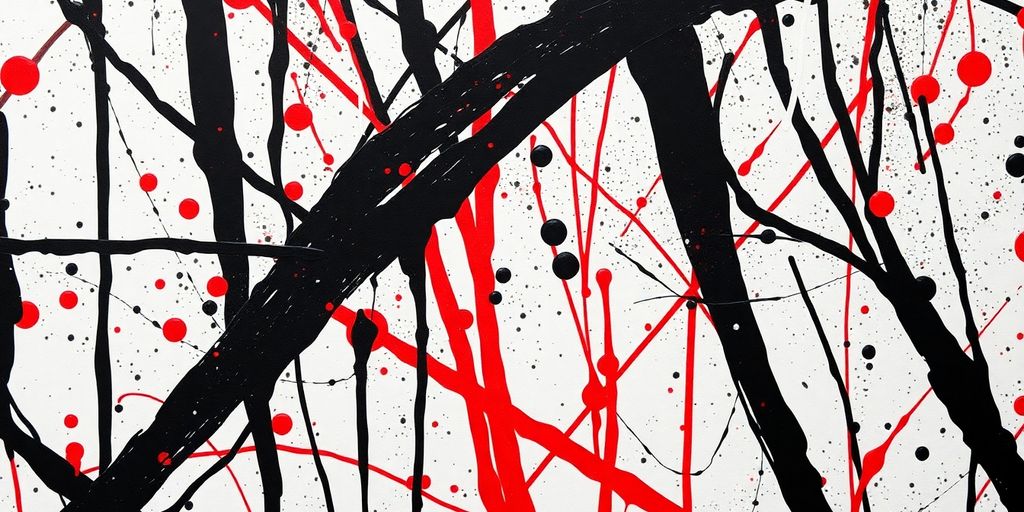
Have you ever looked at a Jackson Pollock painting and wondered what’s really going on? It might seem like just a bunch of drips and splatters, right? But there’s so much more to it. Pollock’s unique way of painting, often called ‘action painting,’ was a whole new ballgame. It wasn’t just about putting paint on a canvas; it was about his whole body moving, his emotions, and creating something totally abstract. We’re going to take a closer look at his famous drip technique and some of his most amazing works, exploring what makes a Jackson Pollock painting so special.
Key Takeaways
- Jackson Pollock’s “Mural 1943” was a big deal, a huge canvas that really pushed him towards his famous drip style and changed modern art.
- Works like “Convergence” and “Autumn Rhythm” show how Pollock mixed vibrant colors and lines, creating a sense of controlled chaos that’s captivating.
- Pollock’s art, like “The Deep,” is sometimes seen as having deeper meanings, possibly connecting to Jungian ideas about the unconscious mind.
- Even though his paintings look wild, Pollock had a real knack for balancing spontaneity with composition, making his work feel both energetic and harmonious.
- His move to non-representational art, seen in pieces like “Shimmering Substance,” and his later choice to use numbers instead of titles, showed a big shift in his artistic journey.
The Genesis of Action Painting
Before Jackson Pollock became a household name for his radical drip paintings, his artistic journey took a significant turn with a monumental commission. This period marked the birth of what we now call "action painting," a style that emphasized the physical act of creation. It wasn’t just about the final image; it was about the energy, the movement, and the artist’s direct involvement with the canvas. This shift was a departure from traditional methods, inviting viewers to consider the process as much as the product.
The Revolutionary Drip Technique
Pollock’s most famous innovation, the drip technique, fundamentally changed how paint was applied. Instead of using brushes in the conventional sense, he would drip, pour, and splash paint onto canvases laid out on the floor. This method allowed for a more direct, almost primal connection between the artist and the artwork. This physical engagement with the materials was central to his new approach. It was a way to bypass the usual constraints of the easel and explore a more fluid, all-encompassing creative process. This technique was a key element in the rise of Abstract Expressionism.
Physicality and Emotional Expression
The act of painting for Pollock became a performance. He would move around and even on the canvas, his entire body involved in the act of applying paint. This intense physicality meant that every flick of the wrist, every step taken, was imprinted onto the work. It was a way to channel raw emotion directly into the art, making the canvas a record of his physical and emotional state at the moment of creation. This visceral connection is what many find so compelling in his work.
Mural 1943: A Monumental Turning Point
Commissioned by Peggy Guggenheim for her New York townhouse, "Mural" (1943) was a massive undertaking that served as a crucial stepping stone. Measuring roughly 8 by 20 feet, its sheer scale pushed Pollock to develop new ways of working. The painting itself is a dense, energetic composition, hinting at the rhythmic, all-over style he would later perfect. It was here that he began to break away from more structured forms, exploring the potential of gestural abstraction. This work is often seen as the first major manifestation of his evolving style, a precursor to the iconic drip paintings that would define his career.
Iconic Works and Their Significance
When you look at Jackson Pollock’s most famous pieces, it’s easy to get lost in the sheer energy. But these aren’t just random splatters; they’re carefully considered compositions. Let’s check out a few.
Convergence: A Masterpiece of Color and Chaos
"Convergence," painted in 1952, is a prime example of Pollock’s mature drip style. It’s a riot of color, with black, white, red, and yellow paint all swirling together. The sheer density of the paint application creates a visual field that pulls you in. It feels both chaotic and incredibly organized at the same time. You can almost feel the movement of the artist’s body as he worked, dancing around the canvas.
Autumn Rhythm: A Masterclass in Drip Style
"Autumn Rhythm (Number 30, 1950)" is another huge canvas that really shows off the drip technique. It’s got this amazing sense of depth, with layers upon layers of paint. The colors are earthy, browns and blacks mostly, which gives it that "autumn" feel. It’s a piece that really makes you think about how Pollock controlled the flow of paint. It’s not just about throwing paint; it’s about guiding it. You can find similar artistic explorations in local art classes, where beginners often start with acrylics due to their ease of use Discover local art and painting classes for all skill levels.
Number One, 1950 (Lavender Mist): An Icon of Abstract Expressionism
This one, often called "Lavender Mist," is a bit more subtle. The title itself, just a number and a color, tells you to focus on the painting itself, not some story. It’s a delicate balance of colors, with those hints of lavender giving it a dreamy quality. It really shows how Pollock could create atmosphere with his technique. It’s amazing to think that something that looks so spontaneous might actually have connections to complex ideas like chaos theory. It’s a painting that feels both vast and intimate.
Pollock’s ability to balance spontaneity with a deliberate, almost rhythmic composition is what makes these works so compelling. They invite repeated viewing, revealing new details and connections each time.
Exploring Deeper Meanings in Jackson Pollock Painting
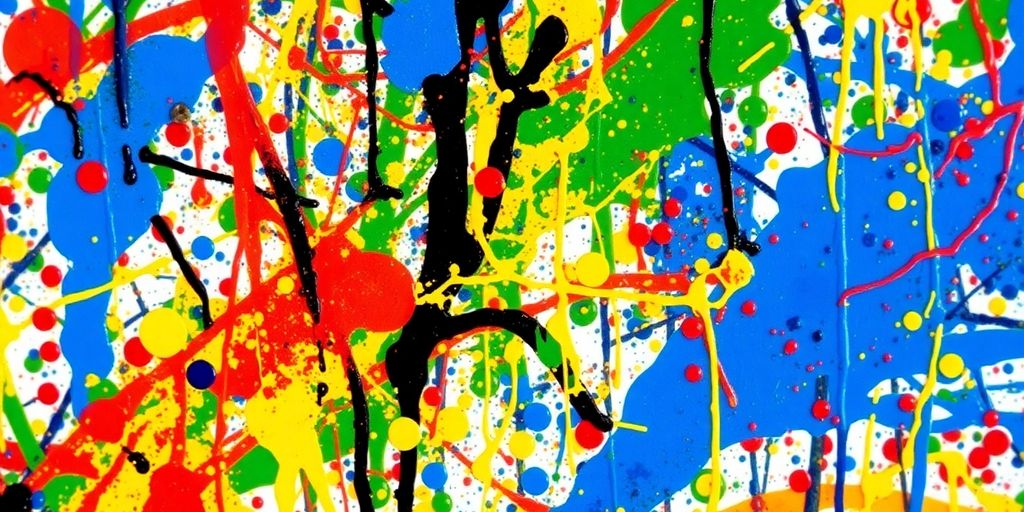
When you look at a Pollock, it’s easy to get lost in the sheer energy of it all. But there’s more going on than just splatters and drips. Many of his pieces really invite you to think about what’s inside, you know, your own head. It’s like he was tapping into something primal, something buried deep within us.
The Deep: Jungian Symbolism in Abstract Form
Pollock was really into Carl Jung’s ideas about the unconscious mind. Think about "The Deep" from 1953. It looks like a dark hole, right? People see it as a way to explore the unconscious, like peering into a well of hidden thoughts and feelings. It’s a heavy piece, and it makes you wonder about the stuff we don’t always talk about.
Mural on Indian Red Ground: Vibrant Backdrop and Inner Turmoil
"Mural on Indian Red Ground," painted in 1950, is a big one, both in size and in what it might mean. The bright red background really pops, and then you have all these energetic lines and drips over it. Some folks think that red isn’t just a color; it’s like a stage for his inner feelings, maybe even his struggles. It’s a really striking piece that shows how he used color to express a lot without saying a word. It’s considered a cornerstone of his work, and it sold for a huge amount, showing its importance in the art world.
Number 5, 1948: Symbolism of Intense Emotion
Then there’s "Number 5, 1948." This painting is a prime example of how Pollock could get complex emotions across through just abstract shapes and lines. It’s a powerful piece that really shows his skill in using paint to talk about feelings. It’s a testament to his unique way of capturing deep emotional experiences. You can see how the web-like structure, which is central to this work, might represent the tangled nature of our own feelings. It’s a piece that really sticks with you, making you think about the intensity of human emotion. You can find out more about this significant work at Pollock’s 1948 painting.
The Art of Controlled Chaos
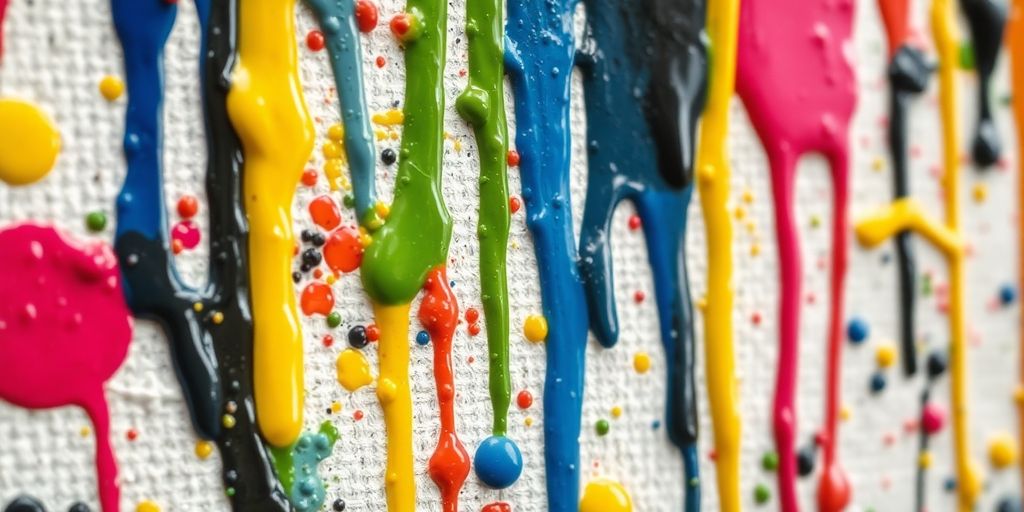
When you first look at a Jackson Pollock painting, it can seem like pure, unadulterated chaos. Splatters, drips, and lines crisscross the canvas with an energy that feels almost wild. But if you look closer, you start to see something else happening. It’s not just random; there’s a definite rhythm and balance at play. Pollock himself said that when he lost contact with the painting, it became a mess, but when he was in sync, there was a pure harmony.
It’s like listening to jazz. If you try to take in every single note at once, it can sound like noise. But if you focus on one instrument, like a saxophone, you can hear beautiful melodies. Pollock’s paintings work in a similar way. You can follow individual lines, and they have a grace to them. When you step back, all these elements come together, creating a pulsing, dynamic feel. It’s a real balancing act, making something that looks so free and spontaneous actually feel so composed.
Balancing Spontaneity and Composition
Pollock’s technique was all about finding that sweet spot between letting go and keeping control. He wasn’t just flinging paint around randomly. He was moving his body, his whole self, in relation to the canvas. This physical engagement was key. He’d squat, crouch, and move around the canvas, letting the paint flow from sticks and cans. This intense physical involvement was the engine of his art, transforming the act of painting into a performance. It’s this dance between his body and the materials that gives the work its unique energy.
The Rhythmic Interplay of Lines and Splashes
Think about the lines in a Pollock painting. They aren’t just lines; they’re like dancers, moving across the canvas. Some are thick and bold, others thin and delicate. They weave and overlap, creating layers of visual information. The splashes of color add another dimension, sometimes jumping forward, sometimes receding. This interplay creates a kind of visual music, a rhythm that draws you in. It’s this careful arrangement of seemingly random marks that makes the paintings so captivating. It’s a style that even hints at concepts found in fractal geometry.
From Perceived Chaos to Actual Harmony
So, is it chaos or harmony? The truth is, it’s both. Pollock masterfully created the impression of wild abandon while maintaining a deep sense of order. He knew that the viewer might see chaos, but he also intended for there to be an underlying structure. This tension between the spontaneous and the controlled is what makes his work so compelling. It’s a testament to his skill that he could translate such intense personal emotion and physical action into something that feels so balanced and harmonious to the viewer. It’s a kind of controlled chaos that invites you to look closer and discover the order within the apparent disorder.
Evolution of a Signature Style
Jackson Pollock’s artistic journey wasn’t a sudden leap into the drip technique; it was a gradual refinement of his approach. He started with more figurative work, then moved through Surrealist influences, and eventually landed on the all-over compositions we associate with him today. It’s like he was slowly shedding old skins to reveal something entirely new underneath.
Shimmering Substance: The Transition to Non-Representational Art
Pollock’s move away from recognizable imagery was a big deal. He wasn’t just painting things anymore; he was painting the act of painting, the energy itself. This shift meant his canvases became fields of color and line, where the viewer’s eye could wander without a specific subject to latch onto. It was about the texture, the rhythm, the sheer presence of the paint.
One: Number 31, 1950 (Lavender Mist): Zenith of Action Painting
This piece is often seen as a high point in his career. It’s massive, and the way the paint is layered – drips, splatters, and pours – creates this incredible sense of depth and movement. You can almost feel the artist’s physical engagement with the canvas. It’s not just paint on a flat surface; it’s a record of motion, a dance captured in pigment.
Abandoning Titles for Neutral Numbers
Pollock’s decision to title many of his works with just numbers, like "Number 1, 1950" or "Number 11, 1952," was a deliberate choice. It stripped away any preconceived notions or stories the viewer might bring.
- It put the focus squarely on the visual experience.
- It treated each painting as a unique entity, not tied to a specific narrative.
- It allowed for a more direct, unadulterated connection between the artwork and the observer.
This move away from descriptive titles was part of a larger trend in abstract art to let the work speak for itself, without the artist’s hand guiding interpretation too heavily. It was about trusting the viewer to find their own meaning in the visual language.
The Enduring Impact of Pollock’s Vision
Jackson Pollock’s work didn’t just hang on walls; it fundamentally shifted how we think about art itself. His whole approach, especially the drip technique, really opened up new avenues for artists. It wasn’t just about making something pretty anymore; it was about the process, the energy, and what the artist was feeling. This focus on the physical act of creation, the raw energy poured into the canvas, still influences artists today. It’s like he showed everyone that art could be a direct expression of the self, unfiltered and powerful.
Transforming the Landscape of Modern Art
Pollock’s "Mural 1943" was a huge deal. It was massive, and it forced him to get creative with how he painted, like working on the floor. This piece was one of the first big signs that American artists were finding their own voice, separate from European traditions. It really helped push Abstract Expressionism forward, making New York a major art hub. His methods, like dripping paint and working around the canvas, were totally new. This wasn’t just a painting; it was a statement about what art could be. It’s amazing how one piece could change so much. You can see echoes of this kind of artistic freedom in digital art tools, like the ones you might find in JS Paint.
Anticipating Chaos Theory and Fractal Geometry
It’s pretty wild when you look at Pollock’s paintings and think about science. His all-over compositions, where there’s no real center or edge, kind of remind you of how things work in nature, like coastlines or snowflakes. The way the paint splatters and creates these intricate patterns, with similar shapes repeating at different scales, is a lot like fractal geometry. It’s like he was intuitively tapping into these complex mathematical ideas long before they were formally recognized in art. It makes you wonder if his art was a kind of visual representation of the universe’s underlying order, even in what looks like pure randomness.
A Legacy of Raw Energy and Expressive Motion
What’s so lasting about Pollock is that visceral connection you feel. When you look at his drip paintings, you can almost feel the movement, the flick of his wrist, the energy he put into it. It’s like you’re right there with him. This physicality is a big part of why his work still feels so alive. He showed us that art could be about more than just the final image; it’s about the journey, the action, the pure expression of being.
- Physicality: The direct link between the artist’s body and the canvas.
- Energy: The sense of movement and dynamism captured in the paint.
- Emotion: The raw, unfiltered expression of the artist’s inner state.
Pollock’s willingness to experiment and break from tradition paved the way for countless artists. His emphasis on process and personal expression continues to inspire creative endeavors across various fields, proving that true innovation often comes from embracing the unexpected and letting go of rigid control. The impact is undeniable, a testament to the power of a singular vision.
Wrapping Up Our Pollock Exploration
So, we’ve taken a good look at Jackson Pollock’s wild drip paintings. It’s clear his method wasn’t just about flinging paint around; it was a whole physical process, almost like a dance. He really changed how people thought about art, making it something you could feel with your whole body, not just see. His work, with all its energy and layers, still makes us stop and think, and maybe even tap our feet a little. It’s a reminder that sometimes, the most powerful statements come from embracing a bit of controlled chaos.
Frequently Asked Questions
What is Jackson Pollock famous for?
Jackson Pollock was an artist famous for his “drip paintings.” Instead of using brushes the usual way, he would pour, drip, and splatter paint onto large canvases laid on the floor. This made his paintings look chaotic but full of energy, and it’s called “action painting.”
What is the “drip technique”?
Pollock’s most famous technique is called the “drip technique.” He would move around the canvas, letting paint drip from cans or sticks he held above it. This allowed him to cover the whole canvas and create complex patterns with lots of movement.
What do Pollock’s paintings mean?
Pollock’s paintings are often seen as having deep meanings. Some people think they show his inner feelings or connect to ideas from psychology, like exploring the unconscious mind. The abstract shapes and colors can make viewers think about their own emotions and experiences.
Are Pollock’s paintings just random messes?
Yes, even though his paintings look wild, Pollock had a lot of control. He carefully planned how the colors and lines would fit together. It’s like a dance between chance and careful choices, creating a balance between what looks like mess and what actually looks good.
How did Pollock change art?
Pollock’s art changed how people thought about painting. His “action painting” style, where the artist’s body movement was part of the art, was very new. It influenced many other artists and made abstract art more popular.
What are some of Jackson Pollock’s most famous paintings?
Some of his most famous works include “Convergence,” “Autumn Rhythm (Number 30),” and “Number One, 1950 (Lavender Mist).” These paintings show different stages of his drip technique and are great examples of his unique style.





 PERFECT PAINTER
Leave a comment