

Michelangelo, a true giant of the Renaissance, is often celebrated for his stunning sculptures, but his paintings are masterpieces in their own right. This article takes a closer look at the painting of Michelangelo, exploring his artistic journey, techniques, and the themes that defined his work. From the iconic frescoes of the Sistine Chapel to the emotional depth of his biblical scenes, we’ll uncover what makes Michelangelo’s paintings so remarkable and enduring.
Key Takeaways
- Michelangelo’s early life in Florence shaped his artistic style and techniques.
- His most famous paintings include the Sistine Chapel ceiling and The Last Judgment.
- Michelangelo was known for his innovative fresco techniques and use of color.
- Symbolism and human emotion are central themes in his artwork.
- His legacy continues to influence artists and art movements today.
Michelangelo’s Artistic Journey
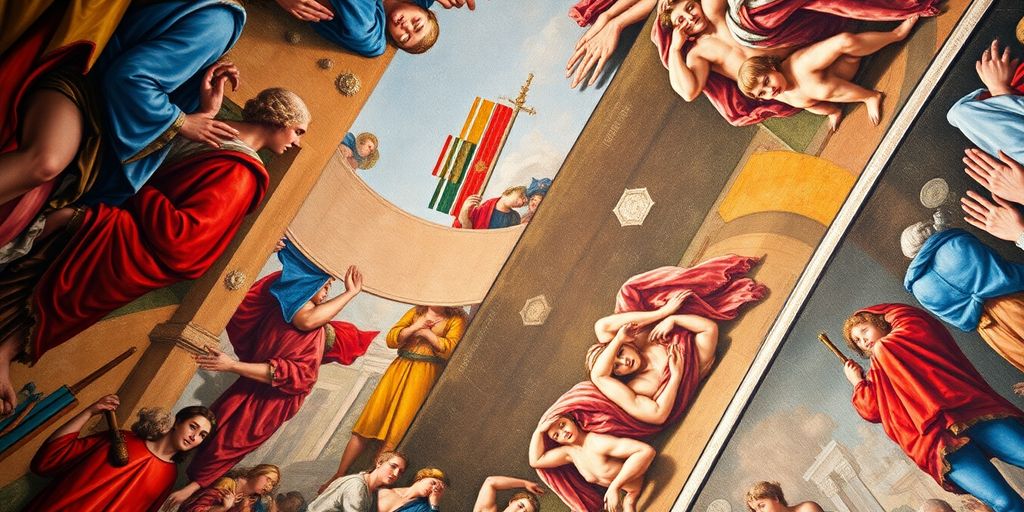
Michelangelo’s path to becoming a Renaissance master is a fascinating story of talent, hard work, and the right opportunities. His early experiences and training laid the foundation for his later achievements. It’s interesting to see how his initial exposure to art and the influences he absorbed shaped his unique style.
Early Years and Foundations
Michelangelo’s story starts in Florence, a city practically overflowing with art and new ideas during the Renaissance. Growing up there, he was constantly surrounded by amazing artwork, which definitely sparked his imagination and helped him develop his skills. Think about it: vibrant colors and classic styles were everywhere, and that had a big impact on his early artistic choices. It’s like he was soaking up the artistic atmosphere from day one. He was lucky to be in such a creative place, and it really shows in his work. It’s amazing how much your environment can influence your artistic development. The Renaissance art movement was a great time to be an artist.
Training and Influences
His training with Domenico Ghirlandaio was a game-changer. Ghirlandaio, a master of fresco painting, gave Michelangelo access to important techniques and a rich artistic history that really shaped his style. In Ghirlandaio’s workshop, classical ideas mixed with new Renaissance innovations, setting the stage for Michelangelo’s genius. It’s like he got the best of both worlds. He learned from a master, but he also had the freedom to experiment and develop his own unique approach. This combination of traditional training and innovative thinking was key to his success. It’s cool to see how his mentor helped him find his own voice. He learned about artistic techniques from the best.
Early Works and Experimentation
Michelangelo’s early works, whether sculptures or sketches, showed a lot of potential. These pieces clearly reflected the influence of classical and humanist studies he was exposed to. He wasn’t afraid to try new things, and that’s what made him so special. He worked with different materials, from marble to tempera paints, each experiment giving him deeper insights into his creative process. The Medici family and other patrons played a big role, giving the young Michelangelo resources and a platform to grow. Here are some key aspects of his early work:
- Early Sculptures: Showed a fascination with human anatomy, showcasing skills in portraying the human form.
- Sketches and Studies: Captured his growing understanding of muscles and movement, influenced by Renaissance humanism.
- Material Exploration: Experimented with various materials to understand form, light, and color.
This period was crucial in shaping Michelangelo’s artistry. It was during these formative years that he began to understand how to manipulate form, light, and color, elements integral to his later masterpieces.
The Masterpieces of Michelangelo
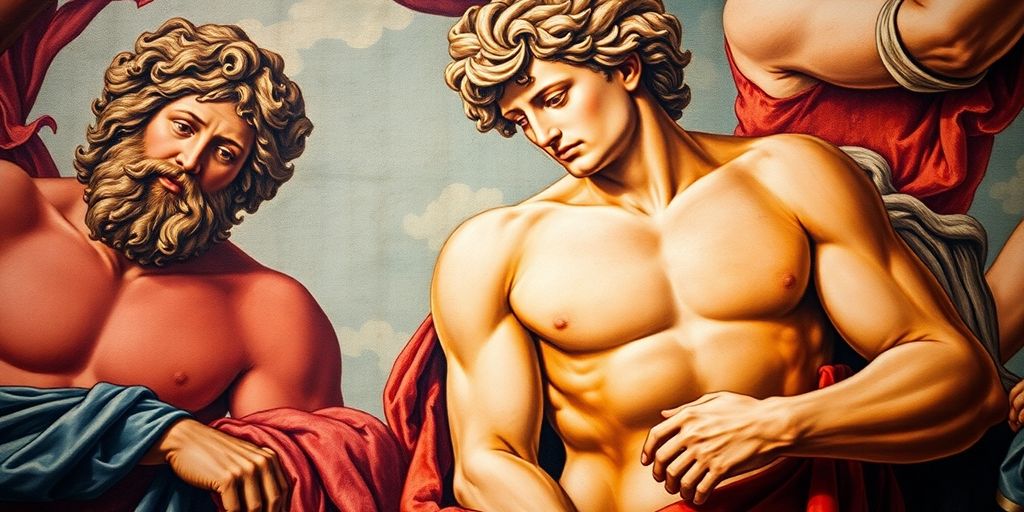
Michelangelo, a true Renaissance man, left behind a collection of works that continue to inspire and awe. While he initially saw himself primarily as a sculptor, his paintings are equally significant. His ability to capture human emotion and anatomy with such precision is what sets his masterpieces apart.
Famous Michelangelo Paintings
Michelangelo’s paintings are not as numerous as his sculptures, but they are incredibly impactful. He wasn’t initially thrilled about painting, especially on a grand scale, but he rose to the challenge and created some of the most recognizable images in art history. It’s interesting to consider that he was largely self-taught, dissecting corpses to understand human anatomy, which greatly influenced his realistic depictions. Some of his famous paintings include:
- The Torment of Saint Anthony (1488)
- The Entombment (1501)
- Doni Tondo (1506)
- The Creation of Adam (1512)
The Creation of Adam
This iconic fresco, part of the Sistine Chapel ceiling, is probably Michelangelo’s most famous painting. It depicts the biblical creation narrative from the Book of Genesis, where God gives life to Adam. The near-touching hands of God and Adam have become a universal symbol of creation and humanity. The composition is simple yet powerful, and the figures are rendered with incredible detail and anatomical accuracy. It’s a testament to Michelangelo’s skill that this single image has resonated with people for centuries. You can explore more about artistic techniques used in this painting.
The Last Judgment
Painted on the altar wall of the Sistine Chapel, The Last Judgment is a massive and complex fresco depicting the Second Coming of Christ and the final judgment of humanity. It’s a departure from the more serene scenes of the ceiling, showcasing a chaotic and dramatic vision of the end times. Michelangelo included a self-portrait in this work, which is a testament to his fiery and volatile nature. He often expressed his ego or rejection of tradition by contentious ways such as putting his own face on characters in his works. The sheer scale and intensity of The Last Judgment are overwhelming, and it remains one of the most discussed and debated works in art history.
Michelangelo’s ability to generate life-like images from marble is unrivaled. He reportedly stated, "I saw the angelic in the stone and chiseled till I let him loose."
Michelangelo’s Fresco Techniques
The Sistine Chapel Ceiling
The Sistine Chapel ceiling, what a project! Pope Julius II wanted something that screamed divine power, and boy, did he get it. Michelangelo took on this huge task, mixing new ways of doing things with pure grit. He used platforms that let him paint way up high, which must have been killer on his neck and back.
- Biblical stories filled the ceiling: Creation, the Fall, the Flood. These weren’t just painted; they were brought to life with amazing dramatic anatomy.
- Michelangelo had to plan everything out perfectly, from the big picture to the smallest detail.
- The sheer size of the ceiling meant he had to figure out how to manage such a large space.
It’s easy to forget how much planning and effort went into the Sistine Chapel. Michelangelo wasn’t just slapping paint on a ceiling; he was telling stories, creating emotions, and pushing the limits of what art could be. It’s a true testament to his genius.
Innovative Use of Color
Michelangelo’s color choices were all about making an impact. He didn’t have the fancy synthetic colors we have today; he used natural stuff. Think earth tones and natural dyes, which gave him a range of colors from soft to super bright. He really liked ultramarine blue, which came from lapis lazuli, a super expensive stone back then. You can see it a lot in the Sistine Chapel. He used colors to make the scenes more emotional and spiritual. Earthy colors made things look real, while brighter colors like vermilion red and ultramarine added drama.
| Color | Source | Use |
|---|---|---|
| Ultramarine | Lapis Lazuli | Accenting key figures, adding depth |
| Vermilion Red | Mineral Cinnabar | Dramatic emphasis |
| Earth Tones | Natural Clays | Creating lifelike qualities |
Dramatic Compositions
Michelangelo was a master of making things look dramatic. He knew how to fill a space with figures that seemed to move and breathe. He used light and shadow to create depth and make certain figures stand out. The way he arranged people in his paintings told a story all on its own. He wasn’t afraid to break the rules and try new things, which is why his art still looks so amazing today. He used the fresco technique, applying pigments onto freshly laid, wet plaster. This method allowed the colors to penetrate the surface and become an integral part of the wall or ceiling.
- He used foreshortening to make figures look like they were coming out of the painting.
- He created a sense of movement by twisting and turning the bodies of his figures.
- He used contrasting colors to draw the viewer’s eye to certain parts of the scene.
Symbolism in Michelangelo’s Work
Michelangelo’s art isn’t just about pretty pictures; it’s packed with meaning. He used symbols to tell stories and convey deep ideas, often drawing from religion, philosophy, and classical literature. It’s like he was speaking a visual language that people at the time understood, but we need to decode it a bit today.
Allegorical Figures
Michelangelo loved using allegorical figures to represent abstract concepts. Think of the figures in the Medici tombs – Dawn, Dusk, Night, and Day. They’re not just people; they embody the passage of time and the inevitability of death. Each muscle and pose is carefully chosen to communicate a specific idea. It’s like he’s giving physical form to something intangible. He was inspired by the old sculpture of Laocoön and His Sons, which was discovered in Rome in 1506.
Religious Themes
Religion was a big deal back then, and Michelangelo’s work reflects that. His paintings in the Sistine Chapel all have a deep Christian subject. The nine panels in the middle area of the roof, each depicting a narrative from the Biblical account. The nine panels are divided into three groups, each containing three scenes. Each one of the three images in the set tells a narrative from the Bible. The last of the three groups illustrates humanity’s problems, namely Noah’s family. All nine panels are said to be a graphic representation of folk’s desire for communion with God. Take The Last Judgment, for example. It’s not just a scene from the Bible; it’s a powerful statement about sin, redemption, and divine judgment. The way he portrays Christ, the Virgin Mary, and the saints is loaded with theological significance. Michelangelo uses color to emphasize the distinction between the worldly and heavenly, but the two are united by the bright yellow of the pulsing of light falling down on Saul. The Sistine Chapel ceiling is a great example of this.
Human Emotion and Anatomy
Michelangelo was obsessed with the human body, and he used it to express a wide range of emotions. His figures aren’t just anatomically correct; they’re full of life, energy, and feeling. He used the human form to evoke emotion, creating figures that practically leaped from the plaster. Think about the way he portrays Adam in The Creation of Adam. He’s not just a naked man; he’s a symbol of potential, longing, and the spark of divine life. The naked individuals in the backdrop are thought to be inspired by the old sculpture of Laocoön and His Sons, which was discovered in Rome in 1506 and credited to the Greek sculptors Polydorus and Agesander.
Michelangelo’s focus on human emotion and anatomy wasn’t just about showing off his artistic skill. It was about exploring the depths of the human experience and connecting with viewers on a visceral level. He wanted to make them feel something, to make them think about their own lives and their place in the world.
Here’s a quick rundown of some key symbolic elements:
- Nudity: Often represented innocence, vulnerability, or a return to a natural state.
- Gestures: Hand gestures and body language were used to convey specific emotions or intentions.
- Color: Colors were carefully chosen to evoke certain moods or associations.
The Evolution of Michelangelo’s Style
Michelangelo’s artistic style wasn’t static; it underwent significant changes throughout his career. You can see it if you look at his early works versus his later ones. It’s pretty interesting to trace how he developed as an artist.
Transition from Sculpture to Painting
Michelangelo was first and foremost a sculptor, and that background heavily influenced his painting. His figures, even in paint, have a sculptural quality, a sense of three-dimensionality that sets them apart. But moving from marble to fresco wasn’t seamless. He had to adapt his understanding of form and light to a new medium. It’s like a chef who’s great at grilling trying to bake – different skills, same artistry.
Changes in Composition
Initially, Michelangelo’s compositions were crowded, filled with intricate detail. Later, his style evolved—compositions became clearer, more straightforward. He started focusing on fewer figures, allowing each one to have more impact. It’s like he learned to say more with less, which is a mark of a true master. The High Renaissance’s dedication to proportionality is evident in his work.
Influence of Patrons
Michelangelo’s patrons, especially the popes, played a huge role in shaping his artistic direction. They commissioned specific works with specific themes, which pushed him to explore new ideas and techniques. He didn’t always agree with their demands, and his fiery personality often clashed with theirs, but their influence is undeniable.
It’s easy to forget that artists like Michelangelo weren’t working in a vacuum. They had to answer to someone, and those relationships shaped the art we see today. It’s a reminder that art is often a product of collaboration, even when the artist is a genius like Michelangelo.
Preservation of Michelangelo’s Art
Surviving Works and Lost Masterpieces
Michelangelo’s artistic output is a mix of surviving masterpieces and unfortunate losses. It’s kind of sad to think about, but we don’t have all of his drawings and sculptures anymore. Apparently, Michelangelo himself destroyed some pieces because they didn’t meet his standards. Can you imagine being that critical of your own work, even if you’re a genius?
Thankfully, some of his most famous sculptures, like the David and the Pietà, have made it through time. Seeing them in person is pretty amazing. But there are still gaps – artworks that we know he created but that are now gone. It makes you wonder what else he might have created. The Pietà sculpture is a great example of his surviving work.
Restoration Efforts
Over the years, Michelangelo’s frescoes and sculptures have faced damage from pollution, humidity, and just plain old age. Restoration is a big deal when it comes to preserving his art for future generations. It’s a delicate process that involves cleaning, repairing, and sometimes even repainting sections of the artwork.
Think about the Sistine Chapel ceiling. It was covered in centuries of soot and grime before a major restoration project in the 1980s and 90s. The restorers carefully removed the dirt, revealing the vibrant colors that Michelangelo originally used. It was a controversial project at the time, with some people worried that the restorers were going too far. But in the end, it helped to bring the artwork back to life.
Impact on Future Generations
Michelangelo’s art continues to inspire artists and art lovers today. His mastery of anatomy, his dramatic compositions, and his innovative techniques have had a huge impact on Western art. He wasn’t just an artist; he was a game-changer. His influence can be seen in the work of later Renaissance and Baroque artists, like Caravaggio and Bernini. Art schools still study his techniques, and museums around the world display his masterpieces.
Michelangelo’s legacy is more than just a collection of paintings and sculptures. It’s a testament to the power of human creativity and the enduring appeal of great art. His work reminds us that art can transcend time and culture, speaking to us across the centuries.
Here are some ways Michelangelo’s work continues to impact future generations:
- Inspiration for artists: His techniques and style are still studied and emulated.
- Cultural icon: His works are recognized and celebrated worldwide.
- Art education: His masterpieces are a staple in art history courses.
The Legacy of Michelangelo
Influence on Renaissance Art
Michelangelo’s impact on Renaissance art is undeniable. His mastery of anatomy and dynamic compositions set a new standard. Artists like Raphael adopted his muscular figures and emotional intensity. His influence extended beyond painting; his sculptural techniques also shaped the artistic landscape. Michelangelo’s work became synonymous with the Renaissance itself, embodying the era’s intellectual and artistic rebirth.
Cultural Significance
Michelangelo’s cultural significance goes beyond just art. His works, especially those in the Sistine Chapel’s ceiling, became symbols of the Renaissance. The Medici family, as patrons of the arts, forever tied their legacy to Michelangelo’s genius. His fiery and volatile nature also added to his mystique, making him a fascinating figure in history. He wasn’t just an artist; he was a cultural phenomenon.
Michelangelo’s art continues to inspire and challenge viewers, prompting reflection on the human condition and the power of artistic expression.
Continued Relevance in Modern Art
Even today, Michelangelo’s influence is felt in modern art. Artists continue to reference his work, finding inspiration in his techniques and themes. Art schools still revere his methods, making him a staple in art education. His innovative use of color and dramatic compositions continue to resonate with contemporary artists. Michelangelo’s legacy is not just a historical one; it’s a living, breathing influence that shapes the art scene today.
- His works are studied and replicated.
- His techniques inspire contemporary artists.
- His themes continue to resonate with modern audiences.
Final Thoughts on Michelangelo’s Art
In wrapping up our look at Michelangelo’s paintings, it’s clear that his work goes beyond just being pretty pictures. His art tells stories, captures emotions, and shows off his incredible skill. Even today, people are still amazed by what he created. From the Sistine Chapel to the Doni Tondo, each piece reflects his unique style and deep understanding of the human form. Sure, he’s often remembered for his sculptures, but his paintings deserve just as much love. They’re a big part of what makes him a true giant of the Renaissance. So, whether you’re an art lover or just curious, Michelangelo’s masterpieces are definitely worth exploring.
Frequently Asked Questions
What are some of Michelangelo’s most famous paintings?
Michelangelo is known for several famous paintings, including the Sistine Chapel ceiling and the Creation of Adam. His works are celebrated for their detail and emotional depth.
How did Michelangelo learn to paint?
Michelangelo learned to paint by training under skilled artists in Florence. He was influenced by the vibrant art scene around him and also studied anatomy to improve his understanding of the human body.
What techniques did Michelangelo use in his frescoes?
Michelangelo used a technique called fresco, where he applied water-based paint onto wet plaster. This method allowed the colors to bond with the wall and become a permanent part of the surface.
What themes are common in Michelangelo’s artwork?
Many of Michelangelo’s artworks explore themes of religion, human emotion, and the beauty of the human form. He often depicted biblical scenes and figures with great intensity.
How did Michelangelo’s style change over his career?
Michelangelo’s style evolved from detailed and crowded compositions to clearer and more dramatic arrangements. His later works show a greater emphasis on the human form and emotional expression.
Why is Michelangelo considered a significant artist?
Michelangelo is significant because of his incredible skill in both sculpture and painting. His works have had a lasting impact on art and continue to inspire artists and audiences today.





 PERFECT PAINTER
Leave a comment